
You run a website. Maybe it’s a blog, a forum, a media site, or a small project that’s slowly getting attention. One day, an email arrives from your hosting provider. It mentions DMCA.
Your first thought is probably: “Did I do something wrong?”
That reaction is normal. Almost everyone feels the same the first time.
Now let me explain what DMCA actually means for you, in a calm and clear way.
Table of Contents
DMCA is Not Pointing a Finger at You
Here’s the first thing you should understand.
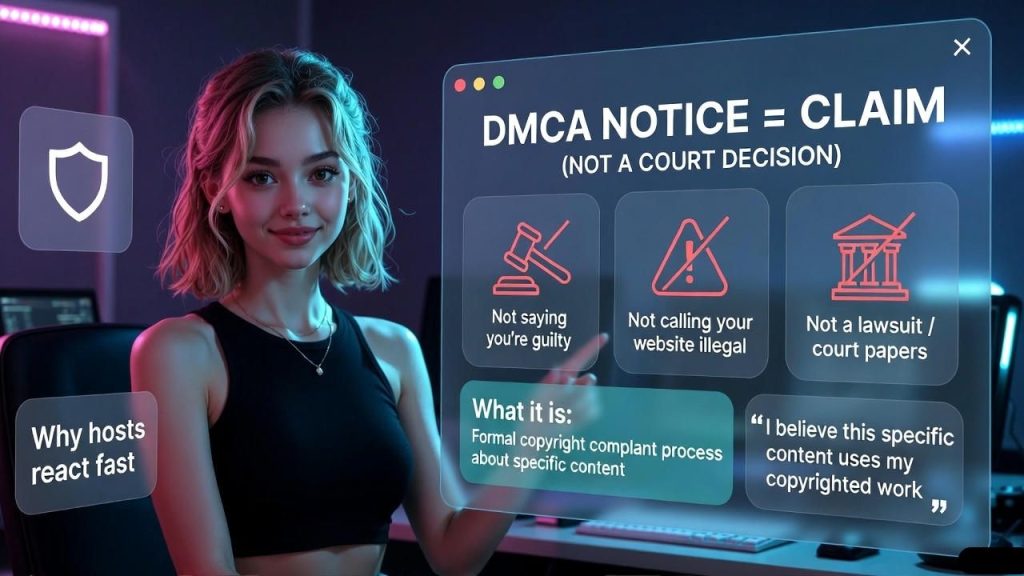
DMCA is not saying you are guilty.
It is not calling your website illegal.
It is not a court decision.
DMCA is simply a formal complaint process.
Someone is saying:
“I believe this specific content on your website uses my copyrighted work.”
That’s all. Nothing more at that stage.
So Why Does DMCA Exist at All?
Good question.
Before DMCA, hosting companies could get dragged into legal trouble very fast. There was no clear system. Everything became messy.
DMCA created a simple rule:
- Copyright owners get a way to complain
- Hosting providers get legal protection if they respond properly
- Website owners get a chance to fix or explain the issue
Think of DMCA as a middle path, not a punishment tool.
What Actually Happens When Your Site Gets a DMCA Notice
Let’s walk through it step by step, like we’re discussing your own situation.
- Someone finds content on your site they believe violates copyright
- They send a DMCA notice, usually to your hosting provider
- Your host reviews that notice
- Then your host contacts you or limits access to that specific content
Notice something important here?
The action is usually about one page, one file, or one post, not your entire website.
Why Your Hosting Provider Reacts Quickly
You might wonder:
“Why is my host acting so fast? Why not ask questions first?”
Because hosting providers operate under legal protection only if they respond quickly. This is called safe harbor.
So when your host forwards a DMCA notice or temporarily disables content, they are:
- Protecting themselves
- Following the law
- Not accusing you personally
This distinction matters a lot.
What DMCA Does NOT Automatically Do
Let’s clear some fear right now.
DMCA does not automatically:
- Shut down your whole website
- Cancel your hosting account instantly
- Take away your domain
- Turn into a criminal case
Most DMCA situations stay small and controlled when handled properly.
Problems grow only when notices are ignored or repeated without action.
Why Even Care If You Are “Doing Nothing Wrong”?
Another fair question.
Many DMCA notices happen because of:
- Images taken from the internet without realizing copyright
- Guest posts using copied text
- User-uploaded files
- Old content you forgot existed
So DMCA is not always about bad intent. Often, it’s about lack of awareness.
Understanding DMCA early keeps you calm later.
What DMCA Really Means for You as a Website Owner
In simple words, DMCA tells you this:
- You are responsible for content on your website
- You are expected to respond, not panic
- You are allowed to fix, remove, or clarify content
- You are part of a system that prefers resolution over conflict
It’s about responsibility, not fear.
FAQs
1. Does DMCA apply to small websites and blogs too?
Yes, it does. DMCA applies to all websites, no matter how small they are. Even a personal blog or a new site can receive a DMCA notice if copyrighted content is published. Traffic size or popularity does not matter. What matters is whether copyrighted material appears on the website.
2. Can I get a DMCA notice even if I didn’t upload the content myself?
Yes, this happens very often. If your website allows user uploads, guest posts, or comments, you are still responsible for what appears on your site. DMCA does not check who uploaded the content. It only looks at where the content is hosted.
3. Is DMCA only for websites hosted in the United States?
No. DMCA is a US law, but it affects websites worldwide. Many hosting companies, even outside the US, follow DMCA rules because they have US connections, US customers, or US based infrastructure. That’s why non-US website owners also receive DMCA notices.
4. Will my website be removed from Google if I get a DMCA notice?
Not automatically. A DMCA notice sent to your hosting provider is different from a Google DMCA removal request. Your site is removed from search results only if a valid complaint is filed directly with Google and approved. Even then, it usually affects specific URLs, not the whole site.
5. How fast do I need to respond to a DMCA notice?
As soon as possible. There is no fixed universal deadline, but hosting providers expect quick action. Delaying or ignoring the notice increases the risk of content suspension or account issues. A calm and timely response usually prevents bigger problems.
6. What if the DMCA claim is false or incorrect?
If you genuinely believe the claim is wrong and you own the content or have permission, you can submit a DMCA counter notice. This tells the host that you dispute the claim. After that, the complainant must take legal action to continue. False claims do exist, but they should be handled carefully, not emotionally.
7. Does using free images or content from the internet protect me from DMCA?
Not always. Many “free” images and resources still have license conditions. Using content without proper permission, attribution, or license understanding can still trigger a DMCA notice. This is one of the most common reasons website owners face copyright complaints without bad intent.
Conclusion
DMCA does not exist to scare website owners.
It exists to manage copyright issues in an organized way.
Once you understand how it works, DMCA loses its power to confuse or intimidate you. You stop reacting emotionally and start handling things logically.
That’s when you stay in control of your website.