
When people start a website, hosting usually feels like a technical decision, storage, speed, uptime. But as a project grows, hosting becomes something much more serious. Complaints start coming in, policies become stricter, and suddenly one notice or report can take an entire server offline without warning.
This is often the point where website owners begin looking into offshore servers.
Offshore servers are widely misunderstood. Some assume they are illegal, while others think they provide total anonymity. The reality sits somewhere in between. An offshore server is not about hiding or breaking rules, it’s about choosing where your server lives and which country’s laws apply to it.
This article explains offshore servers in a clear, real world way, based on how they actually work in modern hosting environments.
Table of Contents
What Is an Offshore Server?
An offshore server is a server, VPS or dedicated that is physically located in a country different from where the website owner or business is based.
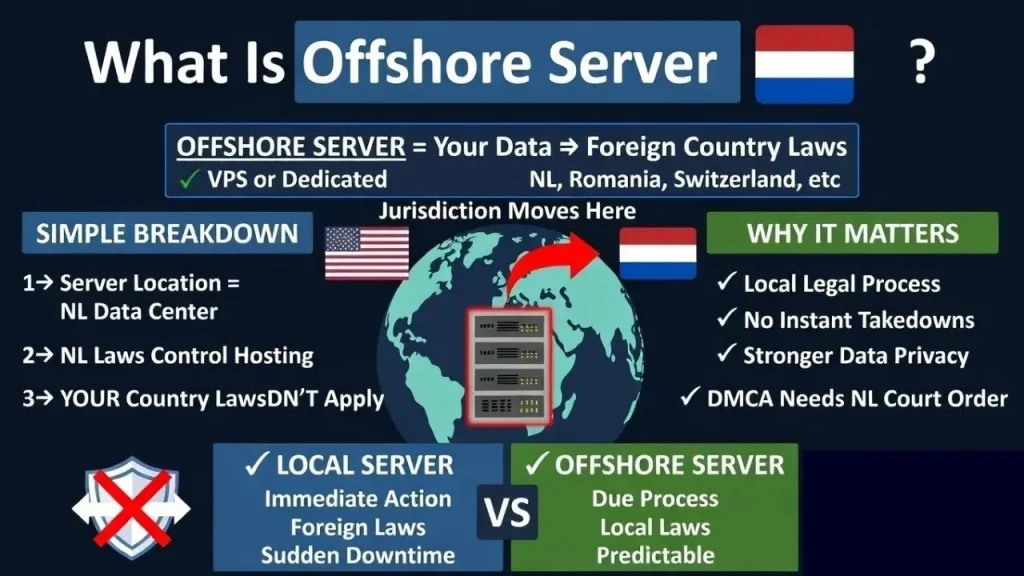
In simple terms:
- Your data is hosted in a foreign country
- The hosting provider operates under local laws of that country
- Legal jurisdiction depends on the server’s location, not your nationality
The key idea is jurisdiction. Hosting your server offshore means your website is governed by the laws of the country where the server is hosted.
Why Offshore Servers Exist
The internet is global, but laws are not. Different countries enforce online rules very differently.
In some regions:
- Complaints lead to instant suspensions
- Hosting providers act first to protect themselves
- Servers are disabled before facts are checked
In other regions:
- Due process is followed
- Legal documentation is required
- Providers act cautiously and proportionally
Offshore servers exist because many website owners want:
- Fewer sudden shutdowns
- Fair handling of complaints
- More predictable hosting behavior
- Better privacy protection
It’s about reducing unnecessary risk, not avoiding responsibility.
How an Offshore Server Works in Practice
From a technical standpoint, an offshore server works just like any other server:
- You rent a VPS or dedicated server
- You install your website or application
- Users access it over the internet
The difference only appears when a problem arises, such as:
- A copyright complaint
- A policy violation report
- A legal request
With an offshore server, hosting providers usually:
- Review the issue under local law
- Require proper legal documentation
- Avoid instant shutdowns unless absolutely necessary
What Offshore Servers Are NOT
This is where confusion often starts.
An offshore server does not mean:
- Illegal content is allowed
- Law enforcement is ignored
- There are no hosting rules
- You are completely anonymous
Most offshore providers strictly ban:
- Child exploitation material
- Malware, hacking tools, botnets
- Scams, phishing, and fraud
- Terrorism related content
An offshore server changes jurisdiction, not criminal accountability.
Types of Offshore Servers
Offshore servers are available in different forms depending on project size.
Offshore VPS Server
- Virtualized server with dedicated resources
- Good balance between cost and control
- Common choice for growing websites
Offshore Dedicated Serve
- Full physical server for one user
- Maximum performance and isolation
- Used for high traffic or sensitive projects
Both options operate under offshore jurisdiction, the difference is scale and control.
Common Offshore Server Locations
Offshore servers are commonly hosted in countries known for strong infrastructure and independent legal systems, such as:
- Netherlands
- Romania
- Moldova
- Luxembourg
- Switzerland
- Hong Kong
These locations are popular because they:
- Have modern data centers
- Require local legal processes
- Do not enforce foreign laws automatically
Why Location Matters for Offshore Servers
All offshore server locations share one important trait:
they do not automatically enforce foreign legal requests.
Instead, providers usually:
- Follow local court procedures
- Require valid legal orders
- Avoid unnecessary service disruptions
This is not a loophole, it is how international law and jurisdiction work.
Offshore Server vs Local Server
On paper, a local server and an offshore server can look almost identical. Same RAM options, similar storage, comparable uptime guarantees. At the beginning, most website owners don’t notice any meaningful difference.
The contrast usually becomes clear only when a complaint arrives, a copyright notice is filed, or regulatory pressure starts building. That’s when jurisdiction stops being a technical detail and becomes the deciding factor.
| Aspect | Local Server | Offshore Server |
| Legal Jurisdiction | Governed by your home country’s laws | Governed by the laws of the hosting country |
| Complaint Handling | Often precautionary or immediate suspension | Reviewed under local legal procedures |
| DMCA & Copyright Reports | Frequently acted on quickly to reduce provider risk | Typically require formal legal documentation |
| Privacy Protection | Standard compliance based protection | Often stronger data protection frameworks |
| Policy Strictness | Strict, liability focused enforcement | More flexible, case by case evaluation |
| Provider Intervention Style | Rapid intervention to avoid escalation | Gradual, process driven response |
| Stability Under Legal Pressure | Service can be interrupted suddenly | Generally more stable during disputes |
In routine conditions, both setups perform similarly. The difference shows up during tense moments. With a local server, providers often act first and review later to shield themselves from liability.
With an offshore server, action is usually tied to formal process and local legal requirements. That slower, structured approach can make the difference between a temporary panic and continued operational stability.
Is Using an Offshore Server Legal?
Yes, offshore servers are legal when used properly.
They are legal because:
- You are allowed to choose where to host data
- Using foreign services is permitted
- Providers follow their local laws
Problems arise only when criminal content is hosted, which is illegal everywhere.
Who Should Use an Offshore Server?
An offshore server makes sense if:
- Your content is legal but sensitive
- You face frequent complaints or reports
- Your project cannot afford downtime
- You value privacy and control
- You want hosting with due process
Who Should Avoid Offshore Servers?
Offshore servers are not suitable if:
- You plan to host illegal material
- You want to evade law enforcement
- You intentionally violate international laws
Responsible use is essential.
Advantages and Limitations of Offshore Servers
Key Advantages
- Greater legal flexibility
- Better stability under pressure
- Stronger privacy policies
- Predictable handling of issues
Important Limitations
- Higher cost in some regions
- Distance may affect latency
- Still bound by criminal law
Understanding both sides helps set realistic expectations.
Conclusion
An offshore server is not about hiding or breaking rules. It is about choosing a jurisdiction that handles hosting issues calmly and fairly.
In an environment where enforcement is often automated and aggressive, offshore servers offer something valuable: stability, control, and due process.
For responsible website owners who want predictable hosting behavior and better protection from sudden shutdowns, an offshore server is a legitimate and practical solution built for how the modern internet actually works.